Emily Hayflick / 28 Aug 2026
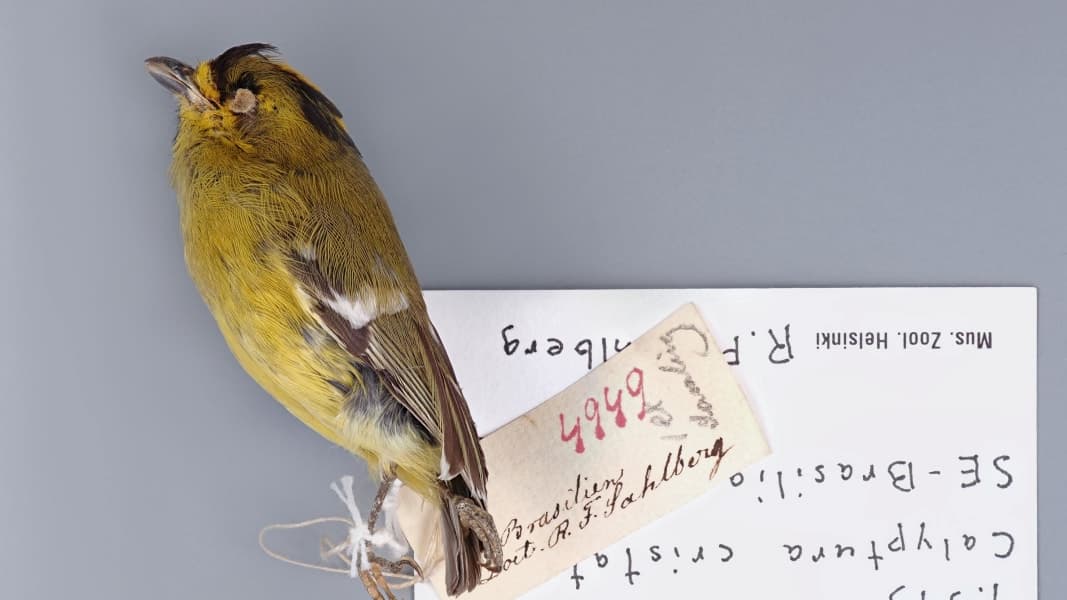
Documentation is the foundation of the Search for Lost Birds. To be rediscovered, a species needs to have a record in the form of a photograph, audio recording or genetic sample, and conversely, it is the lack of these records that leads to a species being lost. While this might sound straightforward, documentation forms come with their own cultural framings, historical contexts, and implications for how they are created and who is able to create them. In a new StoryMap, Emily Hayflick explores these themes of documentation and what they mean for lost birds. Here she reflects on some her experiences researching this project.
See the full StoryMap: Documentation and Lost Birds.
I first became interested in the study of documentation as an archaeology undergraduate, conducting excavations while producing stratigraphic diagrams, written field notes, and artifact illustrations. Because archaeology is a destructive science, archaeological excavations can never be replicated like a lab experiment—where there once were layers of earth and history, all that is left is paperwork, artifacts, and samples. I began to more clearly understand the limits and opportunities of records when I worked with historical archaeological collections in a museum setting, trying to decipher fieldnotes that were written decades ago to contextualize objects within the collection.
As a 2024 Together for Birds Fellow with the American Bird Conservancy, I drew on my experiences as an archaeologist, anthropologist, and former museum professional to explore the production and reception of documentation forms, considering how constructions of authority and veracity intersect with issues of equity and justice. To state it simply, I was interested in understanding who can document a bird through which methods and how this answer changes depending on the circumstances of the recording event. Since the Search for Lost Birds addresses knowledge gaps through specific standards of documentation, the initiative was especially generative for considering how knowledge frameworks shape understandings of species and conservation work.
Looking at the recent re-documentation of the New Britain Goshawk highlights some of the aspects of documenting lost birds that I explored in my fellowship. Prior to 2024, the goshawk, a species classified as vulnerable to extinction by the IUCN, had not been documented since the collection of a specimen in 1969. Although the species had several sightings and was known as extant but rare to local Pomio residents on the island of New Britain in Papua New Guinea, it had not been documented in over fifty years. In March 2024, Tom Vierus, a photographer on a scoping trip with World Wildlife Fund photographed the bird. Though he described the photograph as “unfortunately quite far away,” he still decided to upload the image to iNaturalist. Despite the distance, the image captured the bird’s orange eye and facial markings. Vierus was unaware of the identification and significance of his photograph until members of the iNaturalist community identified the species and highlighted that Vierus’ photograph was the first ever taken of the lost species. Because Vierus’ didn’t initially know he was photographing a lost bird, he was thinking about the quality of the photograph from an aesthetic standpoint, but when he realized that the image was the first documented sighting of the goshawk in over fifty years, the framing and criteria for what made this photograph good quality shifted. Documentation requirements also played a role in to the goshawk being listed as ‘lost’ in the first place. For residents of Pomio, like Oscar Pileng, a World Wildlife Fund officer for the region, the goshawk—known as ‘keango’ or ‘kulingapa’ in the local language—was not a lost bird but instead a rare species known to live in their local forests.
In the StoryMap Documentation and Lost Birds, I explore several case studies similar to that of the goshawk to illustrate how cultural, disciplinary, and project-based contexts shape both the production and response to different forms of documentation. Through this project I hope to provide context for why the Search for Lost Birds has specific documentation standards, and create a resource for thinking critically about the production of species-level records, which has always been important but is increasingly pressing with the proliferation of altered images using generative AI.
Emily Hayflick is a PhD Candidate at Cornell University where she studies environmental anthropology focused on US federal conservation policy and the salvage collecting of protected birds. She has previously worked in museum repatriation, including at the Field Museum and the Smithsonian National Museum of the American Indian. In 2024-2025, she was one of fourteen Together for Birds Fellows hosted by the American Bird Conservancy and worked with John Mittermeier and the Search for Lost Birds to explore how cultural and disciplinary understandings of verification and authority structure people’s relationships to documentation. She is interested in studying the intersections between material culture and conservation, something she explored both in Documentation and Lost Birds and in a Digital Collection Essay written for the Newberry Library.