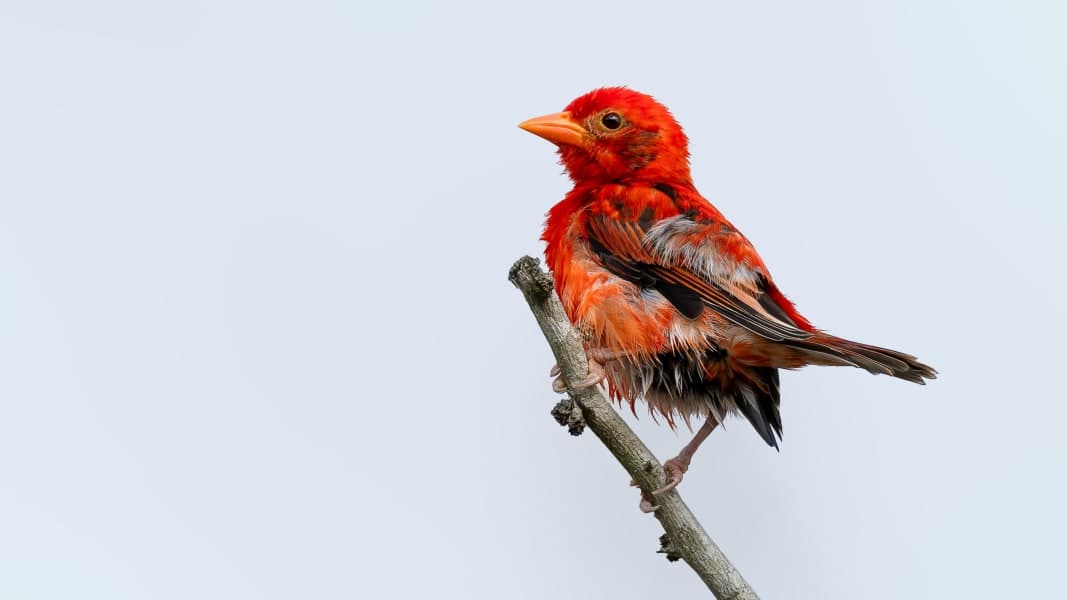
Nina Foster / 4 Aug 2026 / Red Weaver
On the morning of July 3, 2026, two voices rose above the shrill call of the Sombre Greenbul in Kenya’s Boni-Dodori Forest. “Our birds!” they shouted as three flashes of red emerged from a bush. The voices belonged to Kenyan birders James Apolloh Omenya and Simon Odhiambo, who had traveled miles by motorbike in search of a species last documented in 2014. After more than a decade, the lost Red Weaver had finally appeared.
The encounter followed months of planning and years of field experience. Omenya, a 29-year-old ornithologist and bird guide, was one of five recipients of the 2026 Ornis Birding x Lost Birds Expedition Grants. The award supports birders ages 18-30 who wish to find a lost species. He chose two: the Red Weaver, a target of a prior expedition cut short by security concerns, and the Tana River Cisticola, last documented in 1967. Their core ranges overlap in remote areas of northeastern Kenya near the border with Somalia — landscapes rarely visited by birders and ornithologists.
Local Eyes on a Lost Bird
Records of the Red Weaver are sparse. To our knowledge, the species had been photographed only once before Omenya and his team ventured into the field: in April 2014, when John Musina documented a single male in the Boni-Dodori Forest. The limited number of records is due in part to long-standing uncertainty about the weaver’s identity. For more than a century, taxonomists considered the bird a subspecies of the Red-headed Weaver. It was not until 2024 that eBird recognized the Red Weaver as a distinct species, and by 2025 it had cycled onto the Lost Birds list.
To search for this enigmatic bird, Omenya assembled a team that blended scientific expertise, local knowledge, and logistical support. He led the expedition alongside bird photographer Odhiambo, environmentalist Dr. Victor Ikawa, Paul Kaberere of the Environmental Compliance Institute, and East Africa tour guides James Mburu and John Gitiri. Motorcycle riders Mohammed Noor and Charles Manhala of Aweer Conservancy, together with driver Caleb, guided and transported the survey team. Their work relied on a wider network of chiefs, county commissioners, village elders, and armed escorts. In the most remote areas, the Kenya Defense Forces offered protection against the risk of militant activity.
The 11-day expedition ran from June 30 to July 10. The team set off at dawn from Watamu for Hindi, the main gateway and transit point for accessing the Boni-Dodori Forest. There, Chief Jamal advised the team to split into two groups for safety. Omenya and Odhiambo would search for the Red Weaver, while the others would pursue the Tana River Cisticola.
The team navigated a maze of administrative and security checkpoints as they traveled from one village to the next, searching for the lost birds at each location. On their second day, Omenya and Odhiambo were joined by community members from Basuba, whose traditional ecological knowledge proved essential. They recognized the Red Weaver, shared stories of past sightings, and pointed the birders toward two nearby villages.
A Sudden Burst of Scarlet
The breakthrough came while walking from Mangai toward Mararani. The scarlet birds that emerged from the bush were adult male Red Weavers. Omenya sprinted after them, Odhiambo close behind, with Noor, Manhala, and two armed officers in tow.
“For almost two hours, three adult male Red Weavers played hide-and-seek with us through the bush, while two females kept a careful distance,” Omenya remembers. “We photographed, filmed, and recorded them.”
For Odhiambo, the moment brought a combination of joy and serenity. “For the brief moment that the Red Weaver perched before us, we felt peaceful and secure. We were taking photos of this beautiful red bird, and it felt magical as we clicked away,” he recalls.
Male Red Weavers are entirely red, including the bill, and females have gray-brown upperparts, red in the wing, a reddish bill, and pale underparts. While documenting the birds, the pair realized that what appeared to be a third female was not a female at all. It was a young male, later confirmed by analysis of the photographs. “To our knowledge, it’s the first modern evidence that Red Weavers are actively breeding in the Boni-Dodori Forest,” Omenya says.
The team also captured the first known sound recording of the species, filling an important gap in our knowledge of its vocalizations. “This is a great example of why we need to do more to support sound recording in Africa, a region where the avifauna is grossly underrepresented in the scientific archive,” says Cullen Hanks, who has been leading sound recording workshops across Africa with the Cornell Lab of Ornithology for the Big Year of African Sounds. Omenya participated in one of the workshops in February. Hanks adds, “We hope that by supporting talented birders like James, we can better track bird populations in Africa, and make sure fewer African species go ten years without being recorded.”
After their rediscovery, Omenya and Odhiambo rejoiced with the community of Mangai, who cooked five chickens in their honor. The celebration marked not just a rediscovery, but a shared achievement between birders and the people who know the land best.
“We got to spend real time with local communities in places where we were the first birders they'd ever seen working in the area, and birding is now taking root there as people start to understand what we do. The community even gave the Red Weaver its own name, Shongwe Kudhude, meaning ‘the weaver that is red in color,’” Omenya says.
The Cisticola Search Goes On
While Omenya and Odhiambo pursued the Red Weaver, Ikawa, Mburu, and Kaberere began searching for the Tana River Cisticola, a species known from just seven specimens collected in 1932. First described by Melvin Traylor in 1967, the Data Deficient lost bird has no confirmed vocalizations, no photographs, and no modern field records. Previous attempts to locate the species have been unsuccessful.
Like the Red Weaver, the Tana River Cisticola has been a subject of taxonomic debate. Some researchers contend that the museum specimens used to describe the species were aberrant individuals or hybrids of the Ashy, Rattling, or Wailing Cisticola. Finding the bird, coupled with performing DNA analysis on the museum specimens, would resolve any lingering confusion.
The team scoured the lower Tana River Valley for the lost cisticola. Omenya and Odhiambo joined for the second phase of the search after finding the Red Weaver, as did Hassan Golo, who leads the Nature Kenya Tana River Support Group, and Gitiri. They waded through landscapes overrun by invasive shrubs, eyes scanning for a pale, streak-backed, long-tailed bird.
Their surveys revealed an abundance of Coastal Cisticolas, but no lost bird. On two occasions, the team encountered a heavily streaked cisticola whose identity remains unsolved. The markings bore some resemblance to the description of the target species, but close review of the photographs resulted in a provisional Coastal Cisticola identification.
Still, the team made an unexpected discovery. They spotted six Tiny Cisticolas — a notable range extension for the species in Kenya. Although the Tana River Cisticola remains lost, this finding gives Omenya hope. He asks, “If a small, easily overlooked cisticola can be living undetected in a dry habitat like this, could the Tana River Cisticola be doing exactly the same thing, somewhere we haven’t yet thought to look?”
“I think we have to spend time in the Tana area across different months,” explains Ikawa. “The Ijara-Sangole area could look very different seasonally, and the Tana River floods seasonally, which significantly interferes with the midstory and understory birds. The Garsen area also looked uncharacteristically bare.”
Looking Ahead
The Red Weaver is currently classified as Least Concern by the IUCN Red List. However, its population size has not been quantified, and its breeding biology remains almost entirely unknown. Omenya and his team have confirmed that a viable population persists in the Boni-Dodori forest, warranting further research and monitoring.
The Tana River Cisticola search was inconclusive, but its findings will guide future surveys in the region, including an upcoming two-week expedition by Nature Kenya. The Search for Lost Birds is supporting the effort undertaken by staff from the National Museums of Kenya, a member of conservation organization A Rocha Kenya, and two community members from the study area. Their goal is to mist‑net cisticolas; take measurements, photographs, and tissue samples; and record vocalizations.
“The rediscovery of the species would be of great importance to the entire country,” explains Titus Imboma, a National Museums of Kenya researcher who will be leading the expedition. “It would raise the conservation profile of the area as among the most important bird and key biodiversity areas in Kenya. A description of the species, just like the Red Weaver, would create opportunities for tourism and further research in the area.”
Documenting Red Weaver is not just a scientific milestone — it is a testament to what becomes possible when the people closest to these forests are the ones guiding the search. The achievement also resonates beyond Boni‑Dodori, underscoring the importance of supporting young birders in the field.
“The rediscovery of Red Weaver furthers our vision for future monitoring of the world’s least-known species,” says Joshua Bergmark, Ornis Birding Director and Global Tour Leader. “These enthusiastic young birders with just a bit of financial support were very quickly able to find something which has completely eluded everyone else. We are proud to be standing behind these small grants already giving maximum impact, and are inviting applications for next year’s round with a deadline of October 31, 2026.”
When Kenyan ornithologists and communities work together, searches become richer, safer, and more attuned to local ecosystems. The expedition laid a foundation for future work in the form of local partners who are committed to documenting their region’s biodiversity.
“The birding community in Africa is one of the best things happening right now, growing fast across the region,” says Omenya. “We are deeply grateful to Ornis Birding, American Bird Conservancy, and the Ornis x Lost Birds Expedition Grant for making this search possible, and to every guide, driver, security officer, chief, elder, and family who fed us, housed us, walked with us, and trusted us with their knowledge of the land. We’ll be back.”
You can read Omenya’s detailed account of the expedition on the Ornis Birding website.
Nina Foster is a science communication specialist with interests in ornithology, forest ecology, and sustainable agriculture. She holds a BA in English literature with a minor in integrative biology from Harvard University and is currently a biology teacher in Massachusetts.