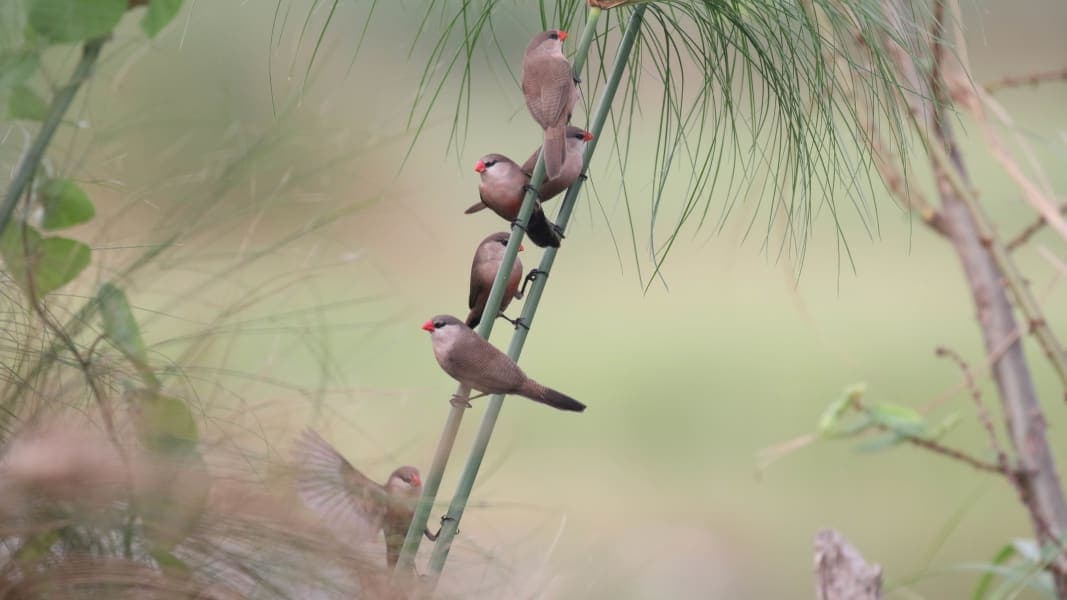
Manuel Weber / 10 Jun 2026 / Black-lored Waxbill
In September 2023, the Black-lored Waxbill (Estrilda nigriloris) was rediscovered in Upemba National Park in the southern Democratic Republic of Congo after being lost for 73 years. While much still remains unknown about this species, a newly published paper in the Bulletin of the African Bird Club provides insights into the bird’s distribution and conservation status as well as highlighting the complexities of conservation in the region.
Recent reporting on Upemba National Park has focused on the 3 March 2026 attack on Lusinga, the park headquarters, in which park staff were killed. The attack underscored the risks faced by conservation personnel in parts of the Democratic Republic of Congo. It also risks narrowing public attention to insecurity alone, although Upemba’s conservation significance remains central.
Upemba National Park covers roughly one million hectares across the Kibara and Manika high plateaus and the Kamalondo Depression, where the upper Lualaba forms a complex of shallow lakes, papyrus marshes, floodplains and wet grasslands. The landscape has never been empty "wilderness", but a populated wetland system shaped by fishing economies, Luba political history, trade routes and changing forms of authority. Since the park’s creation in 1939, conservation in Upemba has repeatedly depended on fragile institutions, uneven territorial control and continued scientific work under difficult conditions.
New records of Black-lored Waxbill show why Upemba National Park remains globally important. Black-lored Waxbill is a highly localised estrildid endemic to the Kamalondo Depression. It was described from specimens collected at Kiabo on the Lualaba River in 1927. Further specimens were collected between 1948 and 1950 at Mabwe, Sombe and Kaleka. After that, the species went without confirmed records for more than seven decades, until its rediscovery at Lake Kabwe in September 2023.
Surveys in 2025 added two new records: approximately 20 individuals at Mabwe, on the shore of Lake Upemba, and a single bird at Kiminunga. The Mabwe observation produced the first high-quality photographs of the species in the wild.
Very little is known about the status of the waxbill. Across 14 surveyed wetland sites in 2023 and 2025, Black-lored Waxbill was detected at only three. Threat pressure for the species is poorly understood but may be substantial. Recurrent fire may affect vegetation structure, seed availability, and increase erosion. Additional pressures include papyrus harvesting, eutrophication and pollution from settlements, destructive fishing practices, mining-related impacts and ecological change following the decline of large herbivores. Black-lored Waxbill is currently listed as Data Deficient. The new evidence suggests that this status may understate potential risk. A formal assessment will require replicated seasonal surveys, estimates of detection probability, delimitation of occupied patches, and a defensible estimate of IUCN-defined “locations” based on the spatial scale of dominant threats.
The Black-lored Waxbill records and the persistence of the Critically Endangered Upemba lechwe (Kobus anselli) confirm that the Kamalondo Depression remains a poorly documented center of endemic biodiversity, while showing that conservation work in the park continues to produce data despite insecurity and long-term ecological pressure. The attack on Lusinga has rightly drawn attention to the vulnerability of the people and infrastructure sustaining conservation in Upemba, but the same attention should also remain fixed on the park’s conservation purpose.
Manuel Weber led the 2023 rediscovery of Black-lored Waxbill. He is interested in remote sensing, ecological monitoring, ornithology, and evidence-based conservation management. He holds an MSc in Environmental Sciences from ETH Zurich and is currently a PhD candidate in Geo-Information Sciences and Remote Sensing at Wageningen University, while working as research and biomonitoring advisor for Upemba National Park, Democratic Republic of Congo.